My walking pad broke (and I panicked)
Oct 06, 2026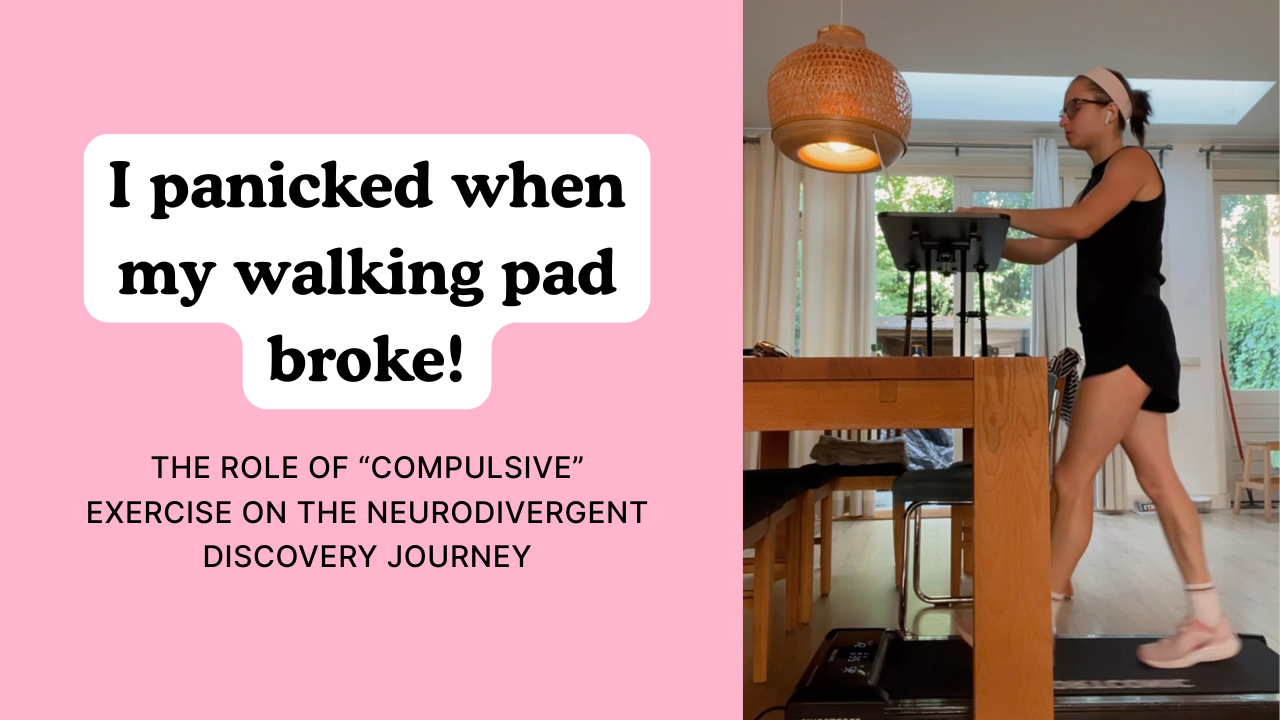
A few days ago, my walking pad broke. (A walking pad is a mini treadmill you can put under your desk to walk while you work.)
Movement has always been a significant source of regulation for me. I genuinely think better and feel more creative when I’m moving. One of my favorite daily routines is writing while walking; it’s as if the physical movement just allows my soul to move more freely onto the page.
While I used to dictate or write notes while going on walks outside, a walking pad has changed the game for me because I can walk while using my laptop!
So when the walking pad suddenly showed an error code, I panicked.
My first thought was an instinctive fear reaction: “How am I going to focus if I can’t walk?”
But my second thought was rooted in “ED recovery culture” – I was immediately reminded of an Instagram reel I saw a few months back in which an ED recovery coach said “If you panic when you don’t get your 10,000 steps in, that’s not health, that’s the eating disorder talking.”
That’s the eating disorder talking…🥴🥴🥴
To be fair, I do think it’s important to have flexibility. If you can’t learn to cope with the inevitable unpredictability of human existence, you will never feel free. It’s also not freedom to have your entire life revolve around routines that you dread. HOWEVER, I think we can all agree that the “ED talking” narrative is SO harmful – especially for neurodivergent people.
For starters, the eating disorder often does not feel like a separate entity. To quote Rainbow Girl: “I despised when people acted as if my eating disorder was some sort of ghost that floated around my head and could be batted off whenever I felt like it.”

When I was deep in my eating disorder – or rather, eating adaptation – it was my entire identity. I did not feel like there was “me” and there was “the ED.” I believed I was the ED. So when people tried to separate “it” from me, I felt like they were trying to rip my soul apart.
Another reason it’s harmful to attribute certain behaviors to “the eating disorder talking” is because many neurodivergent behaviors – including movement – tend to be deeply intertwined with the neurodivergent experience.
Even a decade ago, when I was engaging in an unhealthy amount of exercise, my movement was never “purely ED.” It was largely rooted in my autistic and ADHD need for nervous system regulation. So when people ask me “How do I know if it’s the autism or the ED?” my answer is more nuanced than they might expect (or want).
If you’re autistic, your adaptive eating and movement behaviors are always going to be connected to your autism in one way or another because your entire experience of existence is a neurodivergent one. It’s impossible to separate them into black-and-white categories (again, despite wishing you could!).
Where am I going with all of this? What’s the moral of my broken walking pad story? How did I cope?
After I took a step back (pun intended) and reflected on “the big picture,” I reminded myself of my intentions. I know – or rather, trust – that my walking routine is not an “ED behavior.” I do it because it helps regulate me, and after a lot of curiosity, compassion, trial, and error, I’ve discovered that it genuinely fuels my creativity. HOWEVER, the important distinction between my current movement routines and those I engaged in during anorexia is that I now EAT a lot more because of how much I move.
I no longer have a fear of weight gain, meaning I’m willing to take responsibility for my decisions – including the decisions I make to regulate myself. Rather than using movement as a way to escape, I now use different forms of movement to channel my energy into a life of alignment. But more importantly, movement is no longer the only way I choose to channel that energy. Writing is one of my most meaningful outlets, and it’s something I can also do while sitting if I really commit to the reality of a broken walking pad! 😂
Essentially, I’ve created a relationship with movement that honors my autistic/artistic gifts and, at the same time, aligns with my biological energy needs. Yes, I did panic when my walking pad broke – and I also acknowledged that this wasn’t the end of the world. I am capable of being flexible when the situation calls for it because I have created an identity that can move (pun intended) and adapt to the ever-evolving circumstances of being human.
A few months ago, I hosted my first Discovery Talk “Compulsive” Exercise or Adaptive Exercise?, in which I guided participants step-by-step through the process of creating their unique version of movement freedom beyond the restrictive frameworks of traditional “ED recovery” approaches. Because I wanted to make this talk accessible to more people, the audio version is now available on-demand at livlabelfreebooks.com!
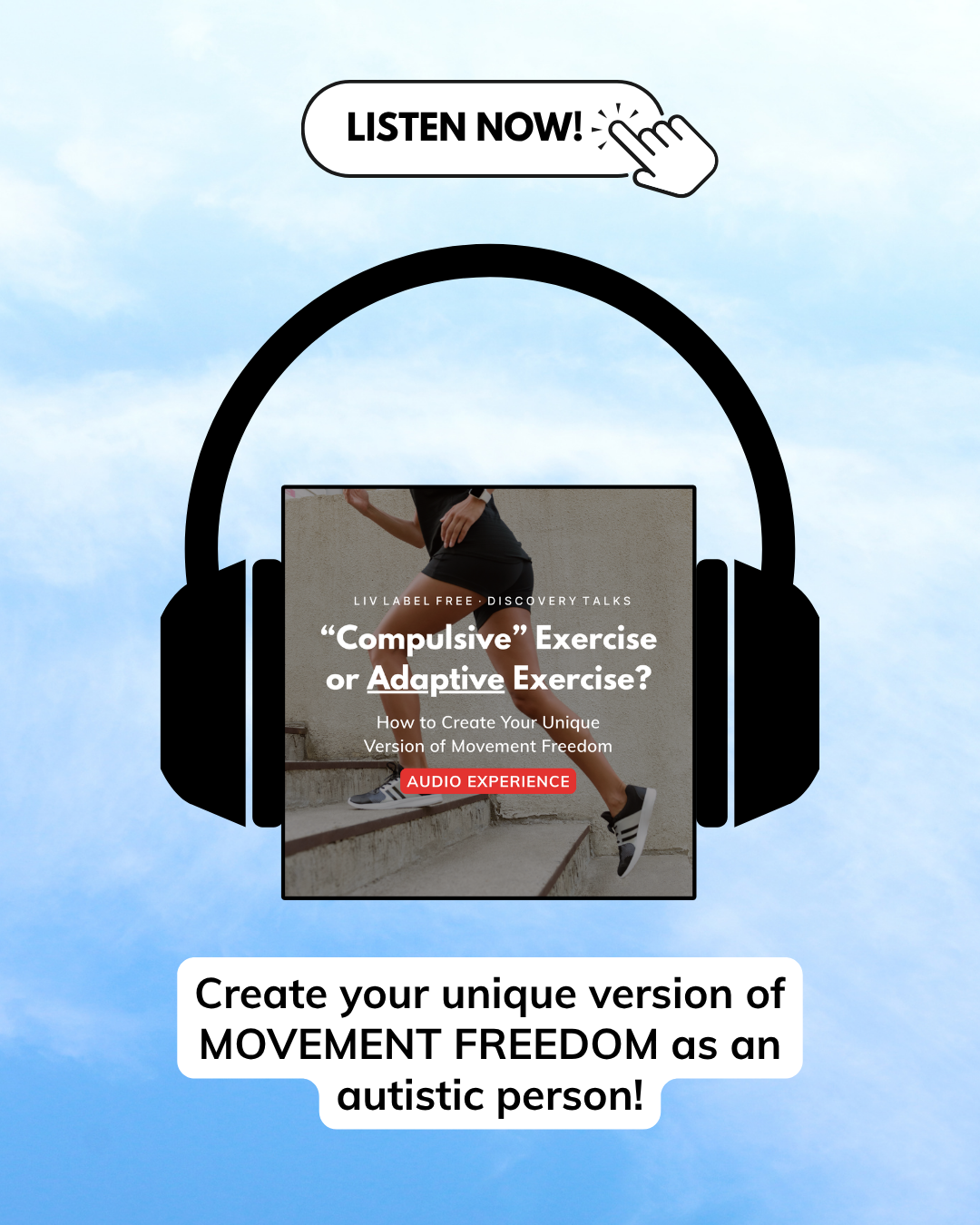
In this 60-minute audio experience, you will learn:
✅ Why autistic and ADHD people are more likely to struggle with exercise
✅ Why “compulsive movement” is actually adaptive movement, and how that distinction changes EVERYTHING on the discovery journey
✅ Why you’re not “addicted” to exercise – you’ve built an identity around it, and identities can be rewritten
✅ How to channel your neurodivergent energy into a relationship with movement that feels like genuine freedom rather than another set of “recovery rules”
✅ A radical reframe in how you understand movement so you can stop fighting your nervous system and start working with it
If you’re ready to create a relationship with movement that honors your autistic need for regulation and honors your equally valid need for physical wellbeing, grab the audio version of the talk here!
Here’s to channeling your energy into a life you don’t need to run away from,
XO Liv
Want to learn how to navigate ED recovery as an autistic person?
Listen to my FREE TRAINING teaching you how to use your autistic traits to your advantage in ED recovery 💪